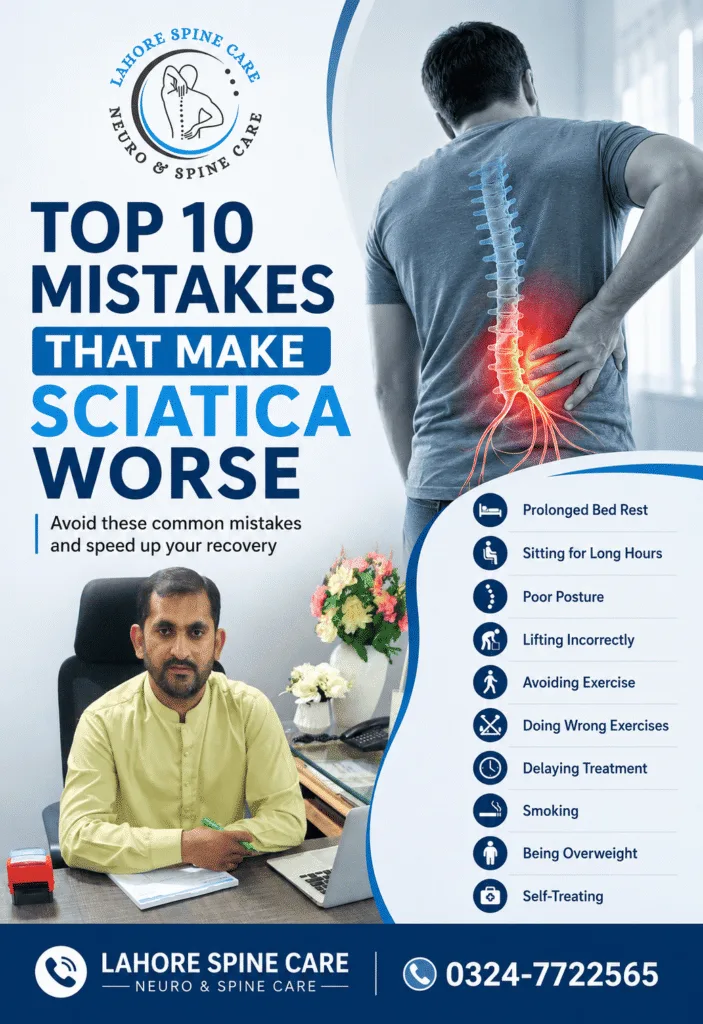
Top 10 Mistakes That Make Sciatica Worse and how to get pain relief at home and at Lahore Spine Care 03247722565.
Sciatica is a common form of leg pain that many people suffer from, especially here in the UK. It happens when the sciatic nerve, the biggest nerve in the body, becomes irritated or compressed, typically because of a herniated disc, spinal stenosis or degeneration of the lumbar spine or your mistakes that make sciatica worse. The pain usually spreads down the leg and into the buttock from the lower back.
Although most people make a quick recovery, there are certain day-to-day routines that can hinder healing and aggravate symptoms. It is helpful to know what these typical errors are, so you can avoid them and get better faster, and avoid chronic pain.
Top 10 Mistakes That Make Sciatica Worse and how to get pain relief at home and at Lahore Spine Care: 03247722565
1. Too Long In Bed
Complete rest is the recommended treatment for sciatica, according to many people. But, if activity is not maintained for long, muscles will become weak, joints stiff, and recovery will be slow.
The literature always suggests that activity should be maintained as much as possible; only for a short time when symptoms worsen.
What to do instead of mistakes that make sciatica worse
- Engage in walking for 10-20 minutes several times a day.
Change positions frequently.
Participate in exercise group, supervised by a physiotherapist.
2. Long Sitting – Sitting For Extended Periods
When sitting, the pressure in the discs of the spine in the lumbar section increases and can worsen compression of the sciatic nerve.
The following groups are especially exposed: Office workers, drivers, students.
Better approach
Stand every 30 minutes.
Use lumbar support.
Sit and stand, when possible.
3. Ignoring Proper Posture
When you have poor posture, the structures of your spine and the surrounding muscles are under a greater stress (mistakes that make sciatica worse)
Common mistakes that make sciatica worse include:
- Slouching
Rounded shoulders
Forward head posture
Leaning while standing
Keeping the spine neutral positions will relieve unneeded pressure on affected nerves.
4. Incorrectly lifting heavy objects
One of the most common sources of injuries to the lumbar discs is improper lifting.
Avoid:(mistakes that make sciatica worse)
- Twisting while lifting
Bending from the hip, waist and knees
Lifting heavy objects using poor lifts.- Using poor lifting technique with heavy loads.
Lift safely
Bend your knees.
Maintain close range distance.
Tighten abdominal muscles.
Avoid twisting.
It is important to not avoid exercise due to pain.It is vital not to avoid exercise due to pain.
5. Avoiding Exercise due to fear of Pain
However, prolonged inactivity:
- Weakens core muscles.
Reduces spinal stability.
Delays healing. - Guided exercise therapy is effective in majority of patients with sciatica, as evidenced.
Recommended exercises include:
- Walking
McKenzie extension exercises (as appropriate)
Core stabilization
Nerve gliding exercises
Prescribed stretching by a physiotherapist (where appropriate)
6. Doing the Wrong Exercises
All exercises are not appropriate for all patients(mistakes that make sciatica worse)
Common mistakes that make sciatica worse include:
- Toe-touch stretches
Heavy squats
Deadlifts when very painful.
Aggressive hamstring stretching
Twisting exercises
Please always ask a qualified physiotherapist before beginning an exercise program.
7. Delaying Professional Treatment
Many people feel the pain and wait for it to go away on its own for months.
Untreated, it can lead to:mistakes that make sciatica worse
Chronic nerve irritation
Muscle weakness
Reduced mobility
Longer recovery
If you notice any of the following, please seek medical evaluation:
- The pain is persistent, longer than 4-6 weeks.
Symptoms worsen.
Leg weakness develops.
Numbness increases.
An issue with bladder/bowel (medical emergency).
8. Smoking
Smoking decreases blood flow to the discs in the spine, which slows down healing and increases disc degeneration.
Research has shown smokers have a higher risk of:
- Disc degeneration
Herniated discs
Chronic low back pain
Persistent sciatica
Smoking cessation is good for the spine and recovery.
9. Being Overweight
Extra weight puts extra strain on the back of the spine in the lumbar area(mistakes that make sciatica worse)
Just a small amount of weight loss can:
- Decrease spinal loading
Improve mobility
Reduce inflammation
Lower recurrence rates- A healthy diet, coupled with regular exercise, will produce the greatest long-term effects.
10. Self-Treating Without Proper Diagnosis
May be due to:
- Lumbar disc herniation
Spinal stenosis
Piriformis syndrome
Degenerative disc disease
Spondylolisthesis
If you’re not aware of the cause, you might use the internet exercises and make mistakes that make sciatica worse.
It is important to have a thorough physiotherapy evaluation to identify the best treatment option.
Some tips on recovery that have been found to be helpful.
The following strategies are supported by research:
- Stay physically active.
Avoid prolonged sitting.
Maintain good posture.
Carry out individual physiotherapy exercises.
Strengthen core muscles.
Maintain a healthy weight.
Stop smoking.
If symptoms persist, seek professional evaluation.
When to see a Physiotherapist?
If you do experience any of the following, seek the advice of a physiotherapist:
Pain that spreads down the leg and into the foot.
Numbness or tingling that lasts over an extended period of time
Muscle weakness
Difficulty walking
Provided that symptoms persist for more than 2 weeks.
Early intervention for Spine Fitness can minimize recovery time and chronic pain.
What makes Lahore Spine Care special?
Lahore Spine Care offers evidence-based physiotherapy for:
Sciatica
Herniated discs
Low back pain
Neck pain
Neck and back pain.
Sports injuries
Postural disorders
Sciatica Treatment
The treatments we offer are:
- Comprehensive assessment
Manual therapy
Therapeutic exercise
Core stabilization
Posture correction
Electrotherapy (when indicated)
Long-term prevention.- patient education.
Conclusion
Many episodes of sciatica can be avoided and the condition can dramatically impact your quality of life. Taking steps to avoid common pitfalls, such as “long bed rest, sitting in an awkward position, lifting improperly, and exercising wrong, will facilitate a quicker recovery and decrease the likelihood of re-injury.
If symptoms do not resolve or are causing difficulty with activities, please consult a registered physiotherapist for a treatment plan that is individual to your symptoms.
References
- Oliveira CB, Maher CG, Pinto RZ, et al. Clinical practice guidelines for the management of non-specific low back pain and sciatica: A systematic review. European Spine Journal. 2018;27(11):2791–2803.
- Qaseem A, Wilt TJ, McLean RM, Forciea MA. Noninvasive Treatments for Acute, Subacute, and Chronic Low Back Pain: A Clinical Practice Guideline. Annals of Internal Medicine. 2017;166(7):514–530.
- Foster NE, Anema JR, Cherkin D, et al. Prevention and treatment of low back pain: Evidence, challenges, and promising directions. The Lancet. 2018;391(10137):2368–2383.
- Jensen RK, Kongsted A, Kjaer P, Koes B. Diagnosis and treatment of sciatica. BMJ. 2019;367.
- Konstantinou K, Dunn KM. Sciatica: Review of epidemiological studies and prevalence estimates. Spine. 2008;33(22):2464–2472.
- Delitto A, George SZ, Van Dillen LR, et al. Low Back Pain Clinical Practice Guidelines. Journal of Orthopaedic & Sports Physical Therapy (JOSPT). 2021;51(11)–CPG60.
- Genevay S, Atlas SJ. Lumbar spinal stenosis. Best Practice & Research Clinical Rheumatology. 2010;24(2):253–265.
- Shiri R, Falah-Hassani K. The effect of smoking on low back pain: A meta-analysis. American Journal of Medicine. 2016;129(1):64–73.e20.