Sciatica vs Piriformis Syndrome – What’s the Difference?
Many people think that their pain is their Sciatica and it’s moving down the leg, but in truth it’s Piriformis Syndrome. While they have similar symptoms, the causes are different and the treatments are different for these conditions.
If you know the difference between sciatica and piriformis syndrome you’ll be able to find the best treatment sooner and save yourself from the constant pain. Physiotherapists at Lahore Spine Care thoroughly evaluate your condition to find out the cause of your pain and will create a specific treatment plan for you.
What Is Sciatica?
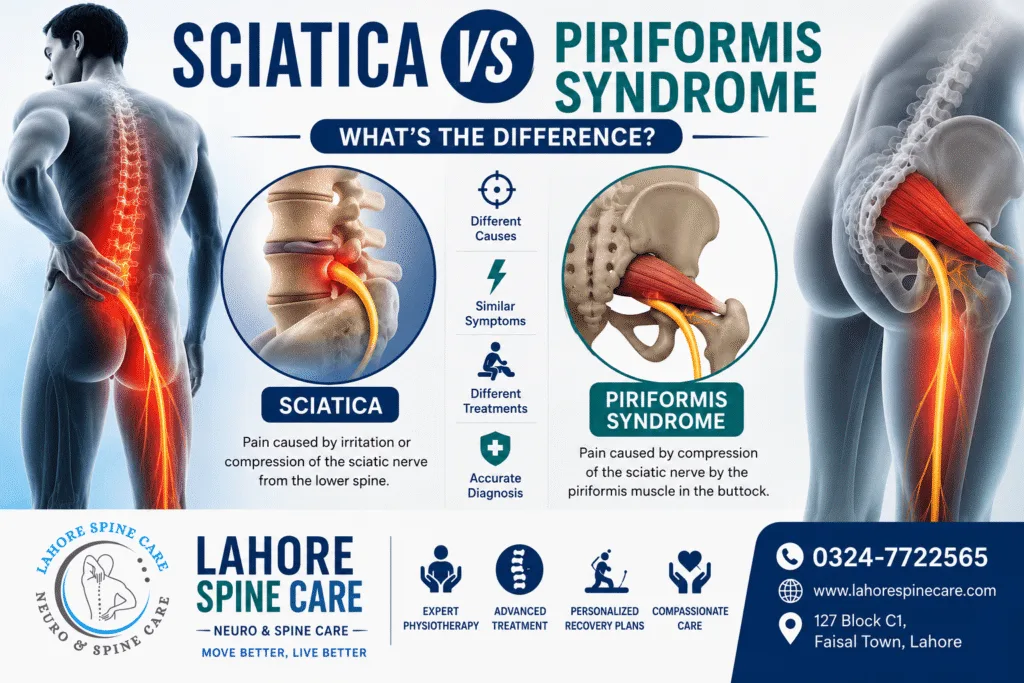
Sciatica is a condition that results from the compression or irritation of the sciatic nerve, typically from the lower spine.
The sciatic nerve is the body’s longest nerve. It starts in the low back, moves down the buttocks and down each leg.
Common causes include:
- Herniated (slipped) disc
Bulging disc
Lumbar spinal stenosis
Degenerative disc disease
Spondylolisthesis
Bone spurs
Compression of the nerves of the lower back.
Sciatica is not a disease itself; it is a symptom of a problem in the spine.
What is Piriformis Syndrome?
- Piriformis Syndrome is the result of the piriformis muscle, a small muscle deep within the buttock, becoming tight, inflamed or spasmodic.
- The irritated muscle can compress the nearby sciatic nerve, causing symptoms similar to sciatica.
- The piriformis syndrome is located in the hip and buttock area, unlike sciatica which is a result of an issue with the spine.
Sciatica and Piriformis Syndrome: Differences are Crucial
| Feature | Sciatica | Piriformis Syndrome |
|---|---|---|
| Origin of pain | Lower spine | Piriformis muscle in the buttock |
| Primary cause | Sciatic nerve fibrosis where it passes through a fibro-muscular sheath | Sciatic nerve fibrosis under the fibro-muscular sheath of the buttocks |
| Lower back pain | Usually present | Often minimal or absent |
| Buttock pain | Common | Usually the main symptom |
| Pain below the knee | Very common | Less common |
| Numbness and tingling | Frequent | Mild or occasional |
| Muscle weakness | May occur | Rare |
| MRI findings | Often abnormal | Usually normal |
| Treatment: Best treatment options | Spine rehabilitation | Stretching and physiotherapy |
Symptoms of Sciatica
Those suffering from sciatica will commonly experience:
Lower back with a sharp pain going down into the leg
Felt as a burning or electric shock-like pain.
Feet or toe tingle, gooseflesh, or goosebumps.
Numbness
Muscle weakness
Coughing or sneezing brings on pain
Leg weakness or inability to walk or stand for extended periods of time.
Some symptoms of piriformis syndrome include:
Typically, piriformis syndrome presents with:
Deep pain in one buttock (less common)
Pressure on the balls of the feet while sitting for extended periods of time.
Pressure pain on the piriformis muscle
Difficulty climbing stairs.
Hip stiffness
Running or long walks, causes pain
Light sensation in the leg.
What Causes Sciatica?
The most common causes of Sciatica are:
Herniated disc
Lumbar spinal stenosis
Degenerative disc disease
Spinal arthritis
Heavy lifting
Obesity
Poor posture
Prolonged sitting
Previous spine injuries.
Why is Piriformis Syndrome Caused?
Common causes include:
- Poor posture
- Poor sitting pattern
- Tight hip muscles
Overuse during sports
Sitting for long periods of time.
Running
Cycling
Muscle imbalance
Injury of the buttock (ischial trauma)
How do you diagnose it?
The diagnosis at Lahore Spine Care starts with a thorough physiotherapy evaluation.
This may include:
Medical history
Postural assessment
Spine examination
Hip mobility testing
Muscle strength testing
Neurological examination
Functional movement assessment
Imaging tests, like MRI or X-rays, may be ordered to look for spinal causes, if needed.
Treatment for Sciatica
Treatment will depend on the cause and may involve:
Physiotherapy
Manual therapy
Sciatic nerve mobilization
Core strengthening
Spine stabilization exercises
Posture correction
Heat therapy
Activity modification
Home exercise program
Most patients will be better with conservative care, rather than surgery.
Piriformis Syndrome Treatment
Piriformis muscle tension release and restoring movement.
It may include:
Piriformis stretching
Hip mobility exercises
Soft tissue release
Manual therapy
Dry needling (if appropriate)
Glute strengthening
Core stability exercises
Posture correction.
Can You Prevent These Conditions?
Yes. Healthy lifestyle practices can help lower the risks of both diseases.
Recommendations include:
Exercise regularly
Stretch daily
Avoid prolonged sitting
Maintain proper posture
Build a strong core.Work the core muscles.
Lift objects correctly
Keep healthy weight level.
Stay physically active.
When to seek the help of a physiotherapist?
See a professional if:
- Pain lasts longer than two weeks
severe Leg pain
Walking becomes difficult
You have numbness or weakness.
Symptoms disrupt or interfere with work or sleep.
Pain repeatedly returns- Early treatment may result in more rapid recovery and long-term benefits.
What makes Lahore Spine Care special?
Lahore Spine Care offers evidence-based physiotherapy treatment for spinal/musculoskeletal conditions.
Our services include:
Sciatica rehabilitation
Piriformis syndrome treatment
Manual therapy
Spine stabilization exercises
Core strengthening
Posture correction
Ergonomic education
Personalized rehabilitation programs
Our purpose is to decrease pain, restore movement and get you back to the activities of daily living.
Complete the Assessment Form in Lahore Spine Care.
Don’t ignore the symptoms if you have persistent pain in your buttocks, back or legs. If the disease is diagnosed early and proper treatment is administered, it is possible to avoid any future complications.
Lahore Spine Care-Locations
📍 127 C1,Faisal Town, Lahore
📍 14-D1, Ghalib Road, Gulberg III, Lahore
📍 DHA Phase 6, Lahore
📍 PCSIR Staff Colony, Lahore
📞 0324-7722565
🌐 www.lahorespinecare.com
Frequently Asked Questions
Can you get sciatica ( Sciaticus syndrome) and piriformis syndrome?
No. Sciatica is the result of irritation or compression of the lower spine’s sciatic nerve. Piriformis syndrome is when the piriformis muscle in the buttock squeezes the sciatric nerve.
Is it possible for the piriformis syndrome to cause pain in the leg?
Yes. It can result in a pain that spreads into the thigh and occasionally down to the knee, but symptoms are typically less severe than those of “sciatica” from the spine.
Which is the common condition?
Spinal issues are more likely to trigger sciatica than piriformis syndrome.
Is there any possibility to treat both conditions with physiotherapy?
Yes. Physiotherapy is an excellent treatment choice for both sciatica and piriformis syndrome as a first line of treatment. Treatment depends on the cause of your symptoms.