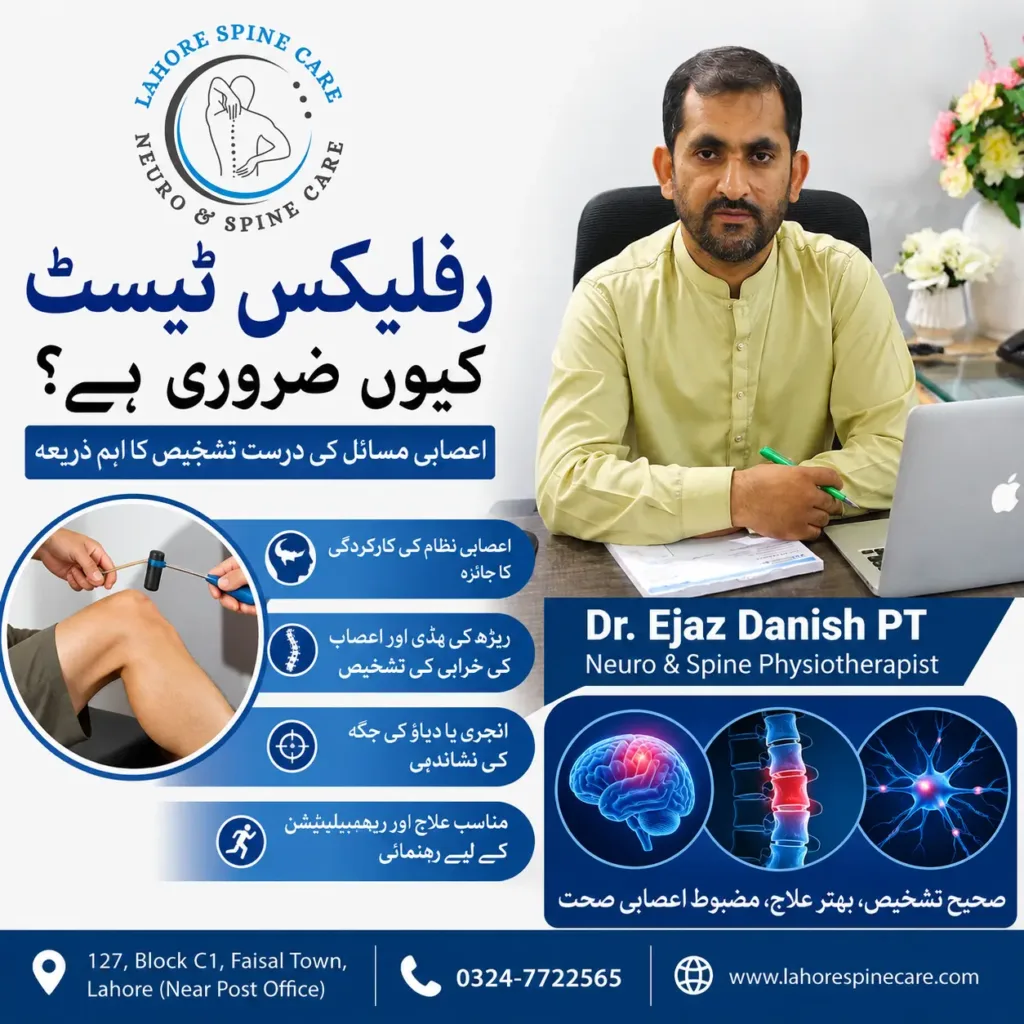
The importance of Reflex Testing in Urdu | Reflexes Examination Urdu
Understand the significance of the reflex tests, the methods used to conduct reflex tests and the meaning of abnormal reflexes when assessed by neurologists and physiotherapists. The neurological evaluation by Dr Ejaz Danish PT at Lahore Spine Care.
Why Is Reflex Testing Important | Reflexes Examination in Urdu.
A reflex is a rapid response of the leg when a doctor lightly strikes the knee with a reflex hammer. Reflex testing is one of the most useful components of a neurological exam even though it appears to be a trivial one. It assists physiotherapists and doctors to assess the functioning of your brain, spinal cord and nerves.
Dr. Ejaz Danish PT (Neuro & Spine Physiotherapist) at Lahore Spine Care conducts detailed neurological assessment such as reflex examination to diagnosis spine and nervous system conditions before designing a customized rehabilitation program.
What is Reflex Test? (رفلیکس ٹیسٹ کیا ہوتا ہے؟)
Reflex testing is a neurological test that tests your body’s automatic responses with a reflex hammer.
رفلیکس ٹیسٹ ایک such test is conducted by striking the different tendons with a reflex hammer (a small hammer used by a doctor or physiotherapist to tap on the body) and making observations about the response of the nervous system.
Reflexes are automatic, meaning that they are not under voluntary control by the patient and so can give objective information about the nervous system.
Why is Reflex Testing important?
Detects Nerve Damage
- Failure to develop or have any reflexes can be a sign of:
- Peripheral nerve injury
Sciatica
Lumbar radiculopathy
Diabetic neuropathy
Disc prolapse - Reflex testing is used to determine if a nerve is normal or not.
Assists in the diagnosis of spinal cord diseases.
Fast (hyperreflexive) reflexes may indicate:
- Cervical myelopathy
Spinal cord compression
Multiple sclerosis
Stroke
Lesions at the level of the upper motor neurons.
Identifies the level of injury to the area.
Every reflex is connected to certain spinal nerve roots:
| Reflex | Nerve Root |
|---|---|
| Biceps | C5-C6 |
| Brachioradialis | C6 |
| Triceps | C7 |
| Knee (Patellar) | L3-L4 |
| Ankle (Achilles) | S1 |
The abnormal findings will aid in identifying the site of the problem.
Recognizes Serious Neurological Conditions at an Early Stage
Examination of reflexes can help to establish:
- Stroke
Parkinson’s disease
Multiple sclerosis
Spinal cord compression
Peripheral neuropathy
Motor neuron disorders
It is used in conjunction with muscle strength, sensation, balance and the patient’s history.
Guides Physiotherapy Treatment
The physiotherapist uses reflex testing to make a decision about:
- Neurological symptoms
- Musculoskeletal symptoms
The severity of nerve involvement
Appropriate rehabilitation strategies
Progress during recovery
Common Reflexes Tested
- Knee (Patellar) Reflex
Ankle (Achilles) Reflex
Biceps Reflex
Triceps Reflex
Brachioradialis Reflex
Plantar (Babinski) Reflex
Each gives significant clues to various components of the nervous system.
What is the meaning of Abnormal Reflexes?
Lack of or weak reflexes.
May be related to:
- Sciatica
Nerve compression
Peripheral neuropathy
Muscle disease
Lumbar disc herniation
Increased Reflexes
May indicate:
- Stroke
Compression of the cervical spine’s spinal cord.
Brain disorders
Injuries to the upper motor neurons.- Damage to the upper motor neuron.
Reflexes are not a diagnosis in themselves, and should be assessed in relation to a complete neurological examination. (Acibadem Hospitals Group)
Reflex Examination at Lahore Spine Care
Dr. Ejaz Danish PT conducts thorough neurological assessment at Lahore Spine Care, which can encompass the following:
- Tests for deep tendon reflexes
Muscle strength testing
Sensory examination
Balance assessment
Gait analysis
Spinal movement evaluation
Nerve tension tests
These findings can be used to develop personalized treatment options for conditions like:
Neck pain
Back pain
Sciatica
Slipped disc
Cervical radiculopathy
Stroke rehabilitation
Peripheral nerve injuries
Spine-related neurological disorders
When do you need to have the reflexes checked?
If you have any of these, think about having a neurological assessment:
- Chronic neck or back pain
Numbness or tingling
Leg or arm weakness
Difficulty walking
Loss of balance
Sciatica
Fast weakness of muscles.
Suspected nerve injury
Early assessment can help to recognize problems early and facilitate prompt treatment.
Conclusion
Reflexes are painless, rapid and very informative parts of the neurological examination. It offers clues to the health of the brain, spinal cord and peripheral nerves and helps the clinician make a diagnosis and direct the proper rehabilitation.
Dr. Ejaz Danish PT and the expert team at Lahore Spine Care offer a thorough neurological assessment and evidence-based physiotherapy to aid in safe and effective recovery from nerve pain, weakness, numbness, and spine related symptoms.