Low-Level Laser Therapy (LLLT) or Photobiomodulation Therapy (PBMT) is is effective for millions of people suffer from musculoskeletal pain, sports injuries, arthritis, neck pain and back pain annually. Low-Level Laser Therapy (LLLT) or Photobiomodulation Therapy (PBMT) is an emerging evidence-based therapeutic approach that complements physiotherapy, although it is not a replacement for it as it is still based on the same principles of exercise and manual therapy.
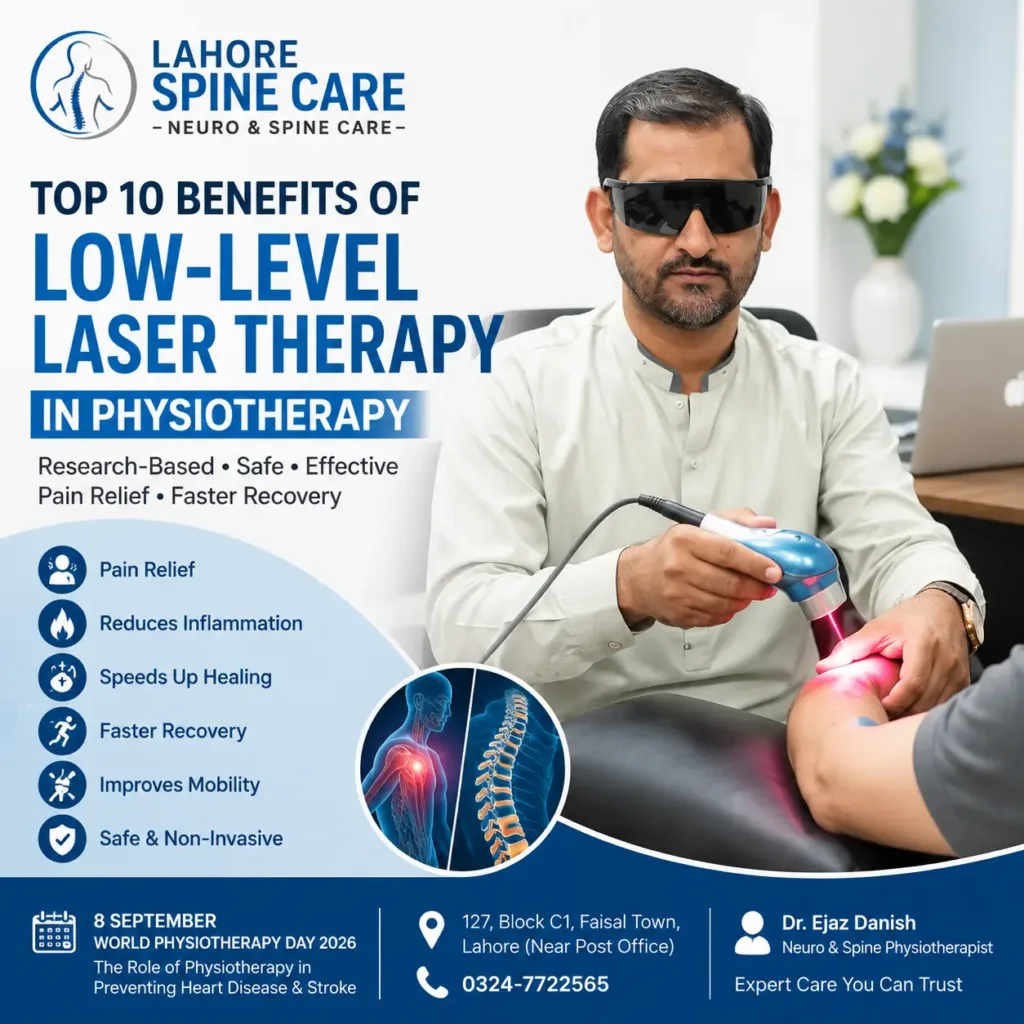
Advanced laser therapy is a component of the Rehabilitation Program designed by Dr. Ejaz Danish (Neuro & Spine Physiotherapist) and the experienced Physiotherapy team at Lahore Spine Care. The aim isn’t only to alleviate pain but to promote healing and function.
Low-Level Laser Therapy (LLLT): What is This?
It involves the stimulation of cells using specific light wavelengths, without the production of harmful heat. The light energy then transmits to the damaged tissues, stimulating the natural healing process through enhanced cellular metabolism, decreased inflammation and tissue repair.
Therapeutic lasers are not invasive, painless or dangerous when used by trained physiotherapists, as are surgical lasers.
Research based benefits
Some of the benefits that have been proven by research are listed below:Here are some of the benefits proven by research:
Reduces Pain Naturally
One of the best benefits of laser therapy is that it helps to decrease pain without the use of medication.
Research shows that laser therapy helps decrease pain by:
- Reducing inflammatory chemicals
Increasing endorphin release
Enhancing blood flow to the area.- Promoting blood flow to the area.
Reducing nerve sensitivity
Uses of LASER in Physiotherapy
sciatica pain relief
Neck pain
Low back pain
Frozen shoulder
Tennis elbow
Heel pain
Knee pain
A systematic review showed that LLLT is effective in decreasing pain in adults with musculoskeletal disorders and that better results are obtained when recommended doses of LLLT are used.
Speeds Up Tissue Healing
Laser therapy activates the body’s repair processes by elevating ATP (cellular energy), boosting collagen production, stimulating fibroblast activity, and stimulating new blood vessel formation. These effects may aid in healing after muscle, tendon, and ligament injury.
Reduces Inflammation
- When the inflammation happens, the pain, swelling and stiffness occur.
- Laser therapy can decrease inflammation through:
- Decreasing inflammatory mediators
Improving lymphatic drainage
Enhancing circulation - This is beneficial for acute injuries as well as chronic musculoskeletal conditions.
Enhances the recovery from sports injury.
- Laser therapy is often incorporated into the rehabilitation program for athletes for the following conditions:
- Muscle strains
Ligament sprains
Tendon injuries
Overuse injuries - There is some evidence that photobiomodulation can be used as an adjunct to rehabilitation to improve recovery.
Supports the treatment of chronic back pain
Low back pain is one of the most common reasons for disability in the world.
Moderate strength evidence suggests that LLLT with an appropriate dose may be effective to alleviate pain for chronic non-specific low back pain for short-term, with or without rehabilitation.
Improves Joint Mobility
Laser therapy can help to minimize stiffness and pain and help patients move more freely.
It is frequently used to treat:
Knee osteoarthritis
Frozen shoulder
Cervical spondylosis
Shoulder impingement
In some patients, it has been shown to be more effective than exercise therapy alone for pain and function, when combined with therapy. (ScienceDirect)
- Strengthens tendons and plantar fascia
- Facilitates the healing of tendons and plantar fascia!
Studies have shown that it benefits:
Achilles tendinopathy
Plantar fasciitis
Patellar tendinopathy
Other lower limb tendon disorders that were not included above.
In cases of lower-extremity tendinopathy and plantar fasciitis, a BMJ Open systematic review revealed the use of LLLT provided significant reductions in pain and disability.
Safe, Non-Invasive Treatment
Laser therapy:
- Requires no injections
Requires no surgery
Is generally painless- Patients can move around normally right after treatment.
Reduces Dependence on Pain Medication
Laser therapy can decrease pain and inflammation, and for some patients, may decrease the need for pain medication as part of a comprehensive treatment program. It should be considered as a single component, rather than a cure, of comprehensive care.
Works Best with Physiotherapy
LLLT therapy is most effective when used with:Studies have demonstrated that laser therapy is most effective when paired with:
- Manual therapy
Therapeutic exercises
Stretching
Posture correction
Patient education
Individualized physiotherapy is a part of the treatment and laser therapy should be used in conjunction with it. ([PubMed Central (PMC)
At Lahore Spine Care, we treat a variety of conditions using laser therapy.We treat many conditions with laser therapy at Lahore Spine Care.
LLLT may be recommended for certain patients suffering from:
Low back pain
Neck pain
Sciatica
Slip disc rehabilitation
Frozen shoulder
Tennis elbow-
Golfer’s elbow
Knee osteoarthritis
Pain in the heel and plantar fasciitis.
Sports injuries
Muscle strains
Ligament sprains
Tendon injuries
Post-operative rehabilitation
Treatment is recommended on person to person basis.
- At Lahore Spine Care, we offer comprehensive and advanced laser therapies.Lahore Spine Care provides advanced laser therapies.
- Advanced laser therapy and evidence-based physiotherapy are combined at Lahore Spine Care to enable patients to recover safely and effectively.
- Each patient is given a customized treatment plan under the care of Dr. Ejaz Danish (Neuro & Spine Physiotherapist) and our experienced rehabilitation team, which can consist of:
Advanced Laser Therapy
Manual Therapy
Neuro Physiotherapy
Spine Rehabilitation
Exercise Therapy
Dry Needling (as appropriate)
Sports Rehabilitation
Home Physiotherapy Services
Post-Surgical Rehabilitation
Stroke Rehabilitation
We want to help you feel better, move better, be stronger and live your life confidently.
Frequently Asked Questions
Does laser therapy hurt?
No. The majority of patients experience little or no sensation during treatment.
How many sessions will be required?
The number of sessions will vary based on the severity of the condition, your response to treatment, and your condition. Your physiotherapist will create a personalized plan.
Is laser therapy safe?
Therapeutic laser treatment is safe when it is administered by trained health care professionals in the proper setting.
Can laser therapy be used instead of physiotherapy exercises?
No. Research indicates that laser therapy may be used in conjunction with exercise & rehabilitation, but not as a substitute. (PubMed Central)
Does laser therapy work for sciatica?
While exercise, manual therapy, and education may be more effective for some with sciatica, the results of laser therapy are best seen when combined with these treatments.
Conclusion
Low-Level Laser Therapy is a cutting edge, evidence-based laser therapy that can be used to help alleviate pain, regulate inflammation, facilitate tissue regeneration and recovery from numerous musculoskeletal disorders. It is not a cure-all, however, good quality research provides support for its use as a component of a comprehensive physiotherapy program.
Advanced laser therapy in Lahore Spine Care can be a suitable option for your tailored rehabilitation program if you are suffering from back pain, neck pain, sports injuries, arthritis or sciatica after a thorough examination by a professional.